PropertyBinder
Property Management Binder for Airbnb Hosts & Landlords
Property Management Binder for Airbnb Hosts & Landlords
Couldn't load pickup availability
Property Management Binder for Airbnb Hosts & Landlords
Keep recurring property-management information in one practical place instead of rebuilding the same checklists, notes, and records every time. This 20-page digital Property Management Binder is designed for Airbnb hosts, independent landlords, vacation-rental owners, and small property managers who want a simple printable system for day-to-day property operations.
The workbook is formatted for US Letter printing and is intended to work alongside the tools you already use. It does not try to replace booking platforms, accounting software, leases, insurance records, or professional advice. Its purpose is narrower: help you organize the property-level information and recurring workflows that are easy to lose across messages, notebooks, spreadsheets, and separate files.
What the Binder helps you organize
The 20-page workbook brings together recurring host and landlord workflows such as:
- Guest information and property guidance
- Emergency and safety information
- Host operations and recurring property checks
- Cleaning and turnover workflows
- Inventory and restocking records
- Maintenance and vendor information
- Guest issues, incidents, and damage documentation
- Property and asset records
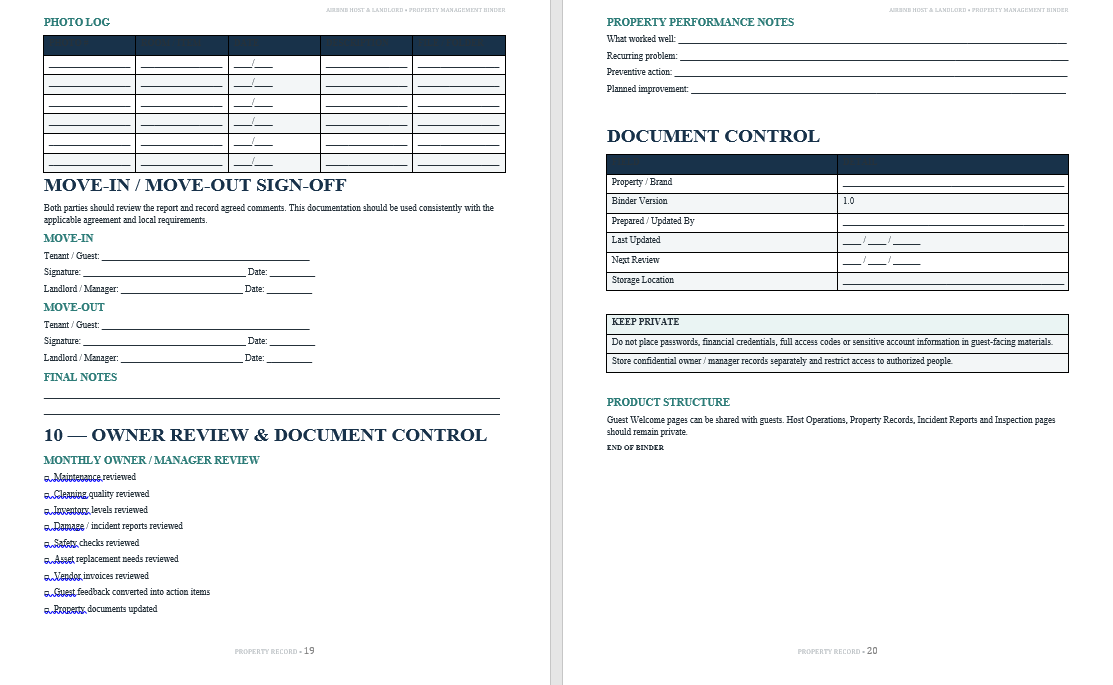
- Move-in and move-out inspection records
The goal is not to create more paperwork. It is to give each recurring task a known place so you can find the information when you actually need it.
Guest information and property guidance
For short-term rentals, guest-facing information can include Wi-Fi details, check-in and checkout instructions, parking information, house guidance, appliance notes, and local recommendations. Keeping those items in a consistent guest section can reduce repeated questions and make updates easier when property information changes.
Private host records should remain separate from guest-facing pages. Passwords, banking information, private account credentials, incident files, and owner-only operational notes should not be exposed simply because they belong to the same property.
Emergency and safety information
The Binder provides a place to organize the property address, important contacts, safety-equipment locations, emergency references, and property-specific information that may be useful during an urgent situation. The exact details should always be adapted to the real property and local requirements.
Technical electrical, gas, HVAC, structural, or other hazardous work should be handled by qualified people. The Binder is an organizational tool, not a technical safety manual.
Cleaning and turnover workflows
Turnovers become easier to repeat when the same rooms and tasks are reviewed in the same order. The Binder is designed to support room-by-room cleaning, final walkthroughs, cleaner handoffs, and property-readiness checks without forcing every issue into the cleaning sheet.
If a cleaner finds a shortage, maintenance issue, or unusual damage concern, that information can be routed into inventory, maintenance, or incident records instead of being buried inside a general cleaning note.
Inventory and restocking
Reusable property items and consumable supplies behave differently. Inventory records can help track what belongs to the property, while restocking records can help monitor frequently used supplies such as toiletries, paper goods, dishwasher products, cleaning supplies, and other property-specific consumables.
This separation makes it easier to distinguish a missing reusable item from an ordinary supply that simply needs to be reordered.
Maintenance and vendor information
Maintenance becomes difficult to manage when repair history lives in text messages and vendor details live in one person's phone. The Binder provides a structured place for maintenance notes, priorities, vendor information, repair status, and follow-up.
For appliances and other important equipment, it can also be used alongside asset records containing make, model, serial information, warranty references, and replacement history where those details are useful.
Incidents and damage documentation
When something goes wrong, the most useful record is factual and organized. A property incident or damage record can include the date, room, affected item, observable condition, photo references, estimates, repair information, vendor details, and final outcome.
The Binder does not determine liability, security-deposit deductions, insurance coverage, or platform reimbursement. Those outcomes depend on the facts, applicable agreements, local rules, and the requirements of the relevant insurer or platform.
Property and asset records
Property operations often depend on information that is rarely needed until something changes: utility-provider details, appliance information, warranty references, access items, property-owned equipment, and document locations. Keeping those records organized can make maintenance, handoffs, and replacements easier.
Sensitive credentials should remain in a secure credential system rather than a general property binder.
Move-in and move-out inspections
A consistent inspection structure helps create a reliable baseline and makes later comparison easier. Use the same room names, condition terms, and photo-reference method at move-in and move-out so records from different dates can be compared without relying on memory.
Inspection pages are intended to document observable condition. Legal classifications such as ordinary wear, damage, or valid deductions can depend on jurisdiction, agreement terms, age, earlier condition, and other evidence.
Who this Binder is for
- Airbnb and vacation-rental hosts who want a printable property-level operating system for guest information, cleaning, inventory, maintenance, and incidents.
- Independent landlords who want one place for inspections, maintenance history, utilities, assets, and move-in/move-out records.
- Small property managers who need a simple handoff structure for cleaners, co-hosts, vendors, or local managers.
- Owners who prefer a hybrid workflow using paper on-site and digital storage for photos, invoices, backups, and larger documents.
What you receive
- 20-page digital Property Management Binder
- Printable US Letter layout
- Property-management checklists, logs, and record-keeping pages
- Digital product for printing and use in your own property workflow
The current product price is displayed on this page by Shopify, so you can see the live amount before purchase.
How to use it
Start with the pages that match your property. Print the sections you expect to use on-site and keep larger supporting files—such as photo sets, receipts, invoices, manuals, or backups—in a digital folder with consistent names. You do not need to use every page for every property.
For multiple rentals, use the same section order and property naming system across each binder. That consistency makes inspections, maintenance history, and management handoffs easier to understand.
Binder vs property-management software
The Binder is not intended to replace software that handles rent collection, tenant portals, automated messaging, accounting integrations, booking synchronization, or portfolio reporting. It is most useful for simple property-level workflows that happen during inspections, turnovers, maintenance visits, and handoffs.
Many owners use both: software for transactions and automation, and a printable binder for on-site operations and records.
What this product is not
The Property Management Binder is an organizational template. It is not legal advice, tax advice, insurance advice, a lease, a statutory notice, a safety certification, or a promise of any platform, review, reimbursement, or dispute outcome.
Rental-property rules, inspection requirements, deposit procedures, notices, safety obligations, and platform policies vary by location and situation. Adapt the workbook to your property, agreements, platform requirements, and applicable local rules.
Frequently asked questions
Is this a physical binder?
No. This is a digital printable product. You can print the pages and place them in your own physical binder if that fits your workflow.
How many pages are included?
The product contains 20 pages.
What paper size is it designed for?
The workbook is designed for US Letter printing.
Is it only for Airbnb hosts?
No. The workbook is designed for Airbnb and vacation-rental hosts, landlords, and small property managers.
Does it replace property-management software?
No. It can be used by itself for simple property-level organization or alongside software for payments, accounting, communication, and automation.
Does it provide legal forms or legal advice?
No. The workbook is intended for operational organization and should be adapted to the laws, agreements, and professional requirements that apply to your property.
A simpler place for recurring property work
If your property information is spread across messages, notes, spreadsheets, and memory, the main benefit of a binder is consistency. Cleaning has a place. Inventory has a place. Maintenance has a place. Incidents have a place. Inspections have a place.
Use the 20-page Property Management Binder as a practical starting structure, then adapt the pages to the way you actually manage your property.
Related PropertyBinder guides
Share